
Dental X-Rays
Advanced diagnostic imaging for a comprehensive view of your oral health.
At Wendani Dental Clinic, we use state-of-the-art dental X-ray technology to get a detailed look at what’s happening beneath the surface of your teeth and gums. This allows us to diagnose problems that are not visible during a regular dental exam, ensuring you receive the most accurate and effective treatment.
Types of Dental X-Rays
These are the most common type of dental X-ray. They provide a high level of detail, allowing dentists to find cavities, check the health of the tooth root and bone surrounding the tooth, see the status of developing teeth, and monitor the general health of your teeth and jawbone.
Types
- Bite-wing X-rays: Show details of the upper and lower teeth in one area of the mouth. Each bite-wing shows a tooth from its crown to the level of the supporting bone.
- Periapical X-rays: Show the whole tooth — from the crown to beyond the root where the tooth is anchored in the jaw.
- Occlusal X-rays: Show full tooth development and placement. Each x-ray shows the entire arch of teeth in either the upper or lower jaw.
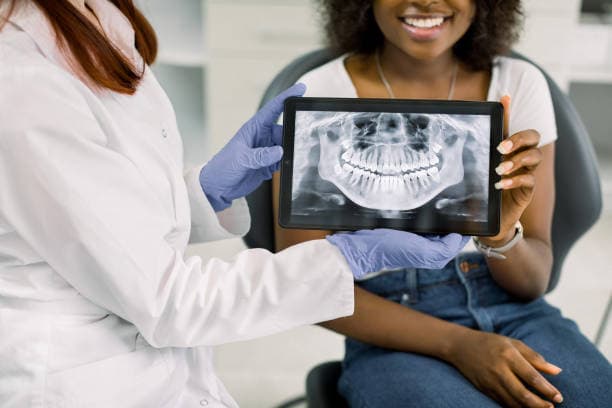
Used to detect dental problems in the jaw and skull. They provide a bigger picture of the patient's oral health, showing the teeth, but also information about the jaw and the temporomandibular joint (TMJ).
Types
- Panoramic X-rays: Show the entire mouth area — all the teeth in both the upper and lower jaws — on a single X-ray.
- Cephalometric projections: Show an entire side of the head. This helps the dentist to examine the teeth in relation to the jaw and profile of the individual.
- Cone beam computed tomography (CBCT): Produces 3-D images of dental structures, soft tissues, nerve paths, and bone in a single scan.
The Dental X-Ray Procedure
The process of getting a dental X-ray is quick, painless, and requires no special preparation. Here’s what you can expect:
- You will be seated in a chair and a lead apron will be placed over your chest and lap to protect your body from radiation.
- For intraoral X-rays, a small sensor will be placed inside your mouth. You will be asked to bite down on it to hold it in place.
- For extraoral X-rays, you will stand or sit in front of the X-ray machine, which will rotate around your head.
- The dental assistant or dentist will then go to a separate area to operate the machine. The actual exposure to the X-ray is very brief.
Are Dental X-Rays Safe?
Yes, dental X-rays are considered very safe. The amount of radiation exposure from a full mouth series of X-rays is very low, approximately equivalent to the amount of radiation a person is exposed to in a single day from natural sources. At Wendani Dental Clinic, we use digital X-rays, which further reduce radiation exposure by up to 90% compared to traditional film X-rays.
Benefits of Dental X-Rays
- Early detection of dental problems such as cavities, gum disease, and infections.
- Less invasive and more accurate diagnosis.
- Enables planning for restorative procedures like implants, dentures, and braces.
- Monitors the development of teeth in children and adolescents.
Conclusion
Dental X-rays are an essential part of a comprehensive dental care plan. At Wendani Dental Clinic, we are committed to using the latest technology to ensure the health and beauty of your smile. Our experienced team will guide you through the process, ensuring your comfort and safety at all times.